Teaching Pronunciation in the EFL Classroom
1. Watch the video introduction to pronunciation below. Please wait a few seconds for the video to load
We have created a podcast to complement this lesson.
If you cannot see the podcast symbol, try using a different browser. IE or Chrome will solve the issue.
2. Listen to the audio podcast below
Teaching EFL Pronunciation Podcast - 19 minutes
Click on the link to play it here: Teaching EFL Pronunciation Podcast
You can download all our podcasts from our podcast page.
3. Basic Concepts
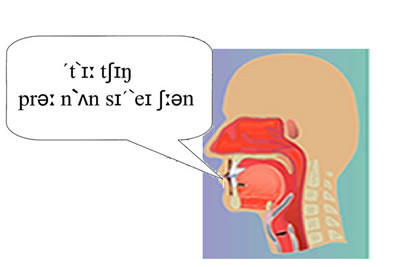
Pronunciation is an area of great difficulty for the untrained EFL teacher. But, with a little training and practice you can facilitate the improvement of your students' pronunciation almost as well as the seasoned professional. For our purposes here, "pronunciation" will include the concepts of stress, rhythm and intonation.
Everyone is familiar with the old jokes about Asian students ordering "flied lice" and, in fact, such pronunciation problems persist today. To a large extent, EFL students have problems with pronunciation and stress primarily due to that fact that their native tongue may not have that particular sound (their native grammar may even prohibit making that sound) and the absence in many languages of "consonant clusters" (strings of consonants such as s-t-r in the word string).
When studying and teaching pronunciation, you will need to learn to use a respelling system to help students get the feel of the language. Some people advocate the use of the International Phonetic Alphabet (IPA), but a problem with that system is that very few students know it and you can spend an inordinate amount of time teaching it to them only to have them move on to another teacher who doesn't use it. Additionally, there are at least ten other major phonetic systems that appear in even the best dictionaries and pronunciation and listening books.
A simple system is used in the listening book Sound Advice and in the pronunciation book Sound Advantage, both authored by Stacy A. Hagen (a link to some excellent YouTube videos by Stacy Hagen is at the bottom of this page). You will see this system used in some of the downloads further down this page. A simple respelling system that is intuitive and easy to use is critical to your success in helping your students succeed in speaking in a comprehensible way. It should be simple and intuitive because you want your students to spend their time on the pronunciation, not on the system.
EFL teachers are all too familiar with students that approach them and speak clear complete sentences of something that is not even remotely understandable. A student may well have a good understanding of English and an excellent vocabulary, but if their pronunciation is so poor that they cannot communicate, all is lost. At least until you come on the scene!
4. Expanded Concepts
Students NEED to hear natural fast relaxed pronunciation as we speak it every day, not a carefully over-articulated overly-pronounced one-word-by-one-word phrasing of sentences. Speaking too slowly and too emphatically is a common characteristic of the untrained teacher.
Speaking unnaturally hurts your students for two reasons. First, they will imitate your speaking style and speak unnaturally too, and second, they will not recognize and understand natural rapid speech when they hear it. This doesn't mean you shouldn't slow your speech down a bit to help your students get some basic ideas, but it does mean that you should speak naturally most of the time. It also means that you need to TEACH them what natural speech sounds like. There is some evidence that says that if students don't speak naturally, they won't recognize normal speech when they hear it.
Consider the following:
My name is Fred really sounds like Mi naeh miz Fred.
How much is it? really sounds like How muh chi zit?
The idea of the end of one word connecting to the beginning of the next word is called "linking" and there is some information about it at the bottom of this page.
If you habitually speak slowly and over-enunciate, your students will listen for How much is it? and won't understand when they hear the normal speech sounds of How muh chi zit? The skilled EFL teacher instructs her students in these differences, how to pronounce them and how to listen for them.
Consider
Sue wants to get a better water heater - say it quickly in normal speech several times and listen to what it really sounds like.
It will sound more like: Sue wuhnstuh gettuh bedder wahdder heeder.
The idea of words sticking together and some sounds becoming smaller is called "reduction" and there is more information about reductions at the end of this page.
There is, of course, some variation by country and region in how we speak.
Learn to use respelling to help your students get it right.
It is important that you get this concept.
Untrained teachers will say, "I don't speak like that!" But they do - you do - everyone does.
What about Respelling?
Should you memorize and use the International Phonetic Alphabet?
No, your students won't usually know it. Look in a variety of books and adopt a simple method similar to the one used above.
Will your students confuse "respelling" with the correct spelling of words?
No, not if you just tell them, "It sounds like this" while pointing at the respelling.
Students intuitively "get it."
Must you respell absolutely correctly?
No, but be as accurate as you can.
The way you respell will be different from someone else as we all have some minor variations in our pronunciation.
5. Word and Sentence Stress
Add to respelling, the notion of word and sentence stress.
Many EFL students around the world will have different stress patterns in their language.
When you pronounce words with two or more syllables, one syllable will be stressed more than the others. Until you practice a bit, you may have trouble hearing stress because it is such a natural part of a native speaker's speech. Here is what to listen for: tone, length of time, loudness.
For example:
Banana - sounds like buh NAEH nuh.
If you listen carefully, the middle syllable has a slightly higher tone, lasts longer and is slightly louder.
As an example of differences, Thai students are likely to say buh naeh NUH. You and I will not likely recognize the word when we hear it from them the first time.
Sentences will have similar stress patterns that students need to learn, and respelling can help them with that too. Some words are not so important to hear and are reduced in time, loudness and tone. Some are more important, louder and longer and have a higher tone. The important words are called "content words". They are nouns, main verbs, adjectives and adverbs. Less important words are called "function words" and are pronouns, helping verbs, conjunctions and prepositions. These rules are not ALWAYS true but are good general guidelines.
Example: My name is Bob when written showing sentence stress sounds/looks like: my NAME is BOB.
Don't overdo word and sentence stress.
It is important to speak naturally when teaching your students stress.
After all, you want your students to speak naturally too.
Think about sentence stress a bit like this. When you talk on a mobile or cell phone, you often don't hear every word and you don't need to. You get the "gist" of the sentence from hearing the important words. Those are the words that are stressed in a sentence. Those are called content words.
Word and sentence stress takes a lot of practice. But the practice is worthwhile as your students will benefit greatly from your efforts. Don't worry about getting it slightly wrong. It is more important that you just try it and work with it and develop your skills with it. Teaching EFL pronunciation takes some practice, but it WILL make you a much better teacher in the long run.
6. Watch the video below
A good overview and a few alternative ideas are in this short video. Good audio examples and only 6.5 minutes.
The narrator is excellent at helping you understand these ideas.
7. Supplemental material
There is a lot to study here as there is a lot to learn. The suggested readings are ranked in the order of difficulty and the order in which they are best read.
Linking - a Word document
Pronunciation Notes - a Word document
Links to Important Readings on Teaching EFL Pronunciation:
8. Stacy Hagen to the rescue - great videos on YouTube - watch the example below
Here is a great video from Stacy Hagen with an excellent review of syllable and word stress and only 7.5 minutes.
Excellent pronunciation videos for EFL students provided by Stacy Hagen (mentioned above on this page) can be found HERE at YouTube. These videos are primarily for EFL students (not for teachers), but they can give you an excellent idea of how to teach the very things we have addressed on this page. Her videos are really worth watching. Stacy is one of the most skilled, practical and straight-forward EFL teachers you will ever find.

We recommend Stacy's excellent pronunciation book Sound Advantage. You can find it used at Amazon for as little a one cent. Postage and handling inside the USA is usually about $4.
Teaching pronunciation (an expressive skill) is the just the other side of teaching listening (a receptive skill). When you are finished with this section, we recommend that you review the Teaching EFL Reading (another receptive skill) and Teaching EFL Listening pages next as these areas fit together like a good jigsaw puzzle. If you ever have the opportunity to teach pronunciation AND listening to the same students and use Stacy Hagen's materials, you will surprise yourself and your students with the great progress they will make.
